
Non-Ferrous Metal Refractories
Refractories for Copper, Lead & Zinc Smelting
STA Commerce coordinates international enquiries for magnesia-chrome and magnesia-spinel refractory bricks used in copper, lead and zinc metallurgy, including flash smelting, Teniente and Peirce-Smith converters, anode furnaces, reverberatory furnaces and Kaldo-TBRC service. Grade and lining-zone requirements are reviewed with relevant refractory suppliers.
Refractory Systems for Smelting, Converting and Fire Refining
Non-ferrous metallurgical vessels are exposed to hot erosion, acidic and calcium-bearing slags, metal oxides, thermal shock, bath movement and repeated oxidation-reduction cycles. The refractory lining must therefore be selected by process, slag chemistry and individual wear zone.
The supplied catalogue identifies shaped refractory products and lining concepts for copper, lead and zinc metallurgy.
Non-Ferrous Process Route
Bricks and Refractory Ceramics in the Catalogue
These entries cover the named commercial grades and the separate Kaldo-TBRC magnesia-chrome specification shown in the catalogue.
Rebonded Magnesia-Chrome Brick
Description
Produced from fused magnesia-chrome co-clinker and chrome ore. It is designed to combine strong slag resistance, structural flexibility and a reduced tendency to hydration.
Catalogue Applications
- Flash smelting furnaces
- Teniente converters
- Peirce-Smith converters
- Copper anode furnaces
- Top-Blown Rotary Converters (TBRC)
- Zones exposed to severe chemical attack and redox reactions
Direct-Bonded Magnesia-Chrome Brick
Description
Manufactured from dead-burned magnesia and chrome ore to provide a direct-bonded refractory structure for demanding non-ferrous metallurgical service.
Catalogue Applications
- Reverberatory furnaces
- Teniente converters
- Peirce-Smith converters
- Other high-temperature non-ferrous metallurgy zones
Direct-Bonded Magnesia-Spinel Brick
Description
Manufactured from high-quality magnesia and synthetic spinel for selected furnace and converter zones requiring a chrome-free refractory option.
Catalogue Applications
- Reverberatory furnaces
- Copper-smelting converters
- Top-Blown Rotary Converters (TBRC)
- Other non-ferrous metallurgical applications
Magnesia-Chrome Brick for Kaldo-TBRC Service
Description
A magnesia-chrome refractory specification presented for rotating Kaldo-TBRC vessels and consumable lining zones in lead and zinc smelting service.
Main Wear Conditions
- Hot erosion caused by vessel rotation
- Chemical attack by slag and metal oxides
- Thermal shock
- Redox reactions during scrap treatment
- Cone, cylinder, permanent lining and bottom zones
Named Refractory Grades and Applications
| Item | MEHR.CHROME.OX60 | MEHR.CHROME.60KX | MEHR.SPIN.60 |
|---|---|---|---|
| Type | Rebonded Magnesia-Chrome Brick | Direct-Bonded Magnesia-Chrome Brick | Direct-Bonded Magnesia-Spinel Brick |
| Raw-Material Concept | Fused magnesia-chrome co-clinker and chrome ore. | Dead-burned magnesia and chrome ore. | High-quality magnesia and synthetic spinel. |
| Applications | Flash smelting, Teniente and Peirce-Smith converters, anode furnaces, TBRC units and severe chemical/redox zones. | Reverberatory furnaces, Teniente and Peirce-Smith converters and other non-ferrous furnace areas. | Reverberatory furnaces, copper-smelting converters, TBRC units and other non-ferrous metallurgy applications. |
Catalogue Magnesia-Chrome Brick Specification
The following property range is shown separately on the Kaldo-TBRC lining concept page. The catalogue does not state that it is identical to any of the three named commercial grades.
| MgO | Cr₂O₃ | Fe₂O₃ | Al₂O₃ | SiO₂ | CaO | Bulk Density | Apparent Porosity | Cold Crushing Strength |
|---|---|---|---|---|---|---|---|---|
| 58–60% | 16–18% | 6–8% | 13–15% | 0–1.5% | 0.5–1% | 2.9–3.1 g/cm³ | 16–19% | 400–600 kg/cm² |
Equipment Covered by the Catalogue
The following process units require different refractory grades, shapes and lining thicknesses in their individual wear zones.
Kaldo-TBRC Converters
Rotating vessels used in copper, lead and zinc metallurgy. Rotation adds hot erosion and mechanical loading to chemical slag attack, thermal shock and redox exposure.
Catalogue Lining Zones
Flash Smelting Furnaces
The furnace consists of a reaction shaft, settler and uptake shaft. Refractories must resist high temperatures and acidic fayalitic, calcium-ferritic or calcium-enriched slags.
Catalogue Lining Zones
Teniente Converters
Submerged tuyere blowing creates intense bath movement and severe wear. The lining requires resistance to hot erosion, process slag, infiltration and oxidation-related spalling.
Catalogue Lining Zones
Peirce-Smith Converters
Refractory selection must address thermal shock, hot erosion, acidic fayalitic slag and copper bursting caused by infiltration of copper oxides, sulfides and metallic copper.
Catalogue Lining Zones
Copper Anode Furnaces
Fire refining removes sulfur and oxygen from blister copper. Bricks protect the bath, burner, tuyere, exhaust-gas, wall and cylindrical zones during oxidation and reduction stages.
Catalogue Lining Zones
Reverberatory and Lead-Zinc Furnaces
The catalogue identifies reverberatory furnace applications for direct-bonded magnesia-chrome and magnesia-spinel bricks, and lead-zinc smelting applications for magnesia-chromite refractories in Kaldo-TBRC-related service.
Selection Basis
Catalogue Product-to-Equipment Coverage
| Refractory Product | Flash Smelting | Teniente | Peirce-Smith | Anode Furnace | Reverberatory | TBRC / Kaldo | Lead & Zinc Smelting |
|---|---|---|---|---|---|---|---|
| MEHR.CHROME.OX60 | Catalogue application | Catalogue application | Catalogue application | Catalogue application | Not specifically stated | Catalogue application | Not specifically stated |
| MEHR.CHROME.60KX | Not specifically stated | Catalogue application | Catalogue application | Not specifically stated | Catalogue application | Not specifically stated | Not specifically stated |
| MEHR.SPIN.60 | Not specifically stated | Copper converter use stated generally | Copper converter use stated generally | Not specifically stated | Catalogue application | Catalogue application | Not specifically stated |
| Kaldo-TBRC Magnesia-Chrome Specification | Not specifically stated | Not specifically stated | Not specifically stated | Not specifically stated | Not specifically stated | Primary catalogue context | Explicitly discussed |
Converter and Anode-Furnace Sections
The diagrams below show examples of converter and anode-furnace lining zones.
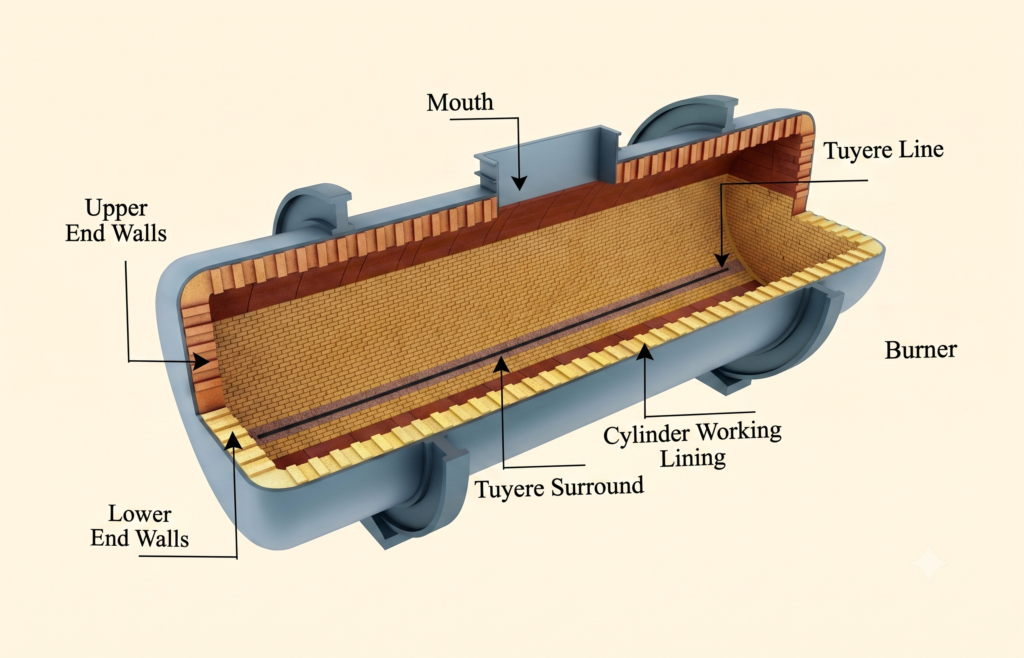
Converter Lining Zones
Illustrates the mouth, tuyere line, tuyere surround, cylindrical working lining and upper and lower end-wall zones.
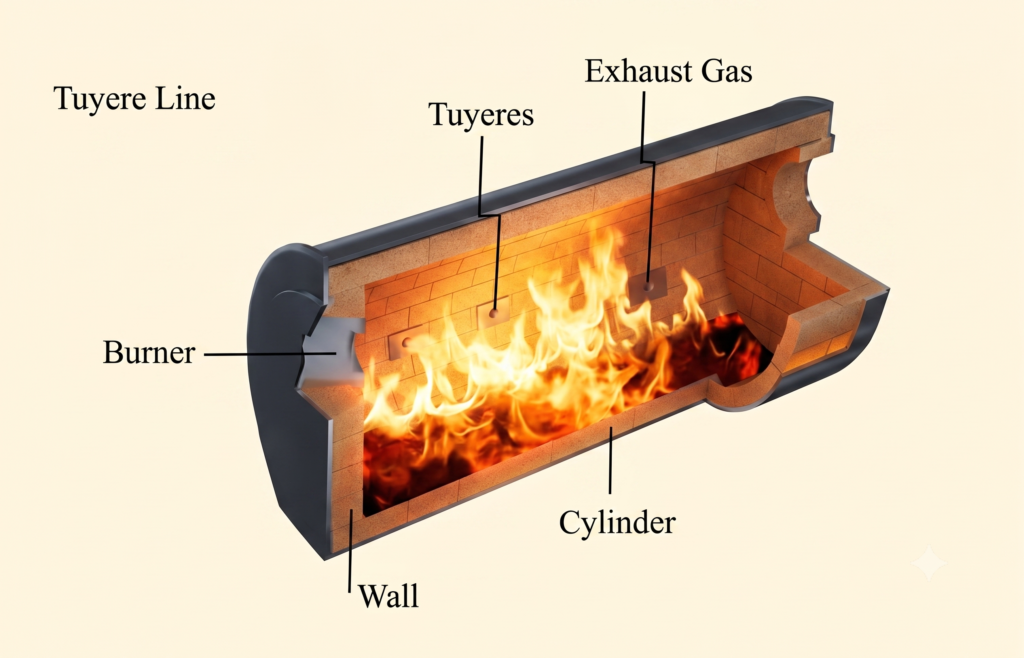
Anode-Furnace Process Zones
Illustrates the refractory areas surrounding the burner, tuyeres, exhaust-gas path, wall and cylindrical bath zone.
Information Required for Technical Selection
Provide the following information so the refractory family, grade, shape and lining configuration can be reviewed accurately.
Related Refractory Products
Explore our refractory products hub and magnesia bricks for related basic-refractory applications.
Request a Non-Ferrous Metallurgy Refractory Quotation
Send us the furnace type, lining drawings, operating conditions, slag chemistry, current refractory grade, dimensions, quantity and destination country for technical and commercial review.