
Tundish Nozzles & Slide Gate Systems for Continuous Casting
STA Commerce coordinates international sourcing enquiries for complete tundish flow-control systems and compatible refractory spare parts. The supply scope can include metering nozzles, exchangeable nozzle-changer mechanisms, three-plate tundish slide gate systems, well blocks, and upper and lower nozzles. The selected mechanism, installation interfaces, dimensions and refractory grades are reviewed with relevant suppliers against the caster drawings before quotation.
Product Diagram, System Types and Published Benefits
The supplied catalogue image is presented as the central technical reference. The structured sections below separate the three systems, their components and their principal operational benefits.
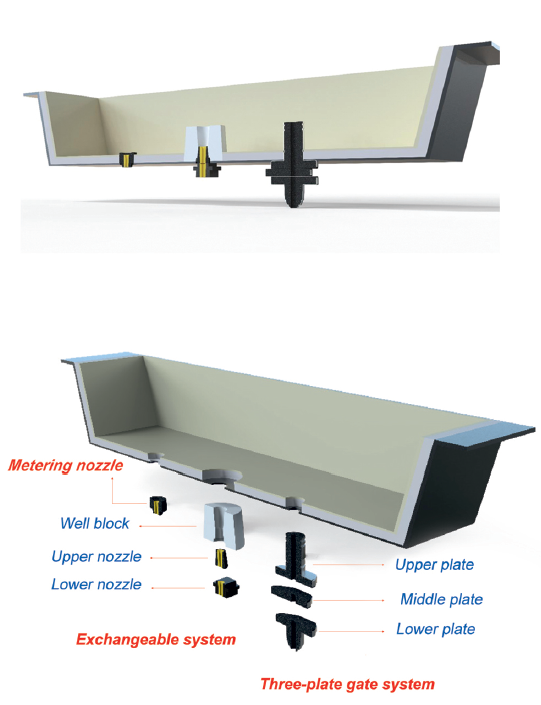
Three Tundish Flow-Control Arrangements
Each arrangement controls molten steel differently and should be selected according to casting practice, required flexibility, safety considerations and equipment design.
Metering Nozzle
A fixed-orifice refractory nozzle, typically incorporating an internal zirconia insert within an alumina-graphite body, regulates flow through its bore diameter.
Exchangeable Nozzle System
A fixed upper outlet element transfers molten steel to a replaceable lower nozzle, allowing the lower flow-control component to be changed during the casting campaign.
Three-Plate Gate System
A movable middle plate changes the overlap between the openings of stationary upper and lower plates, providing adjustable flow control and shut-off capability.
Comparing Tundish Flow-Control Arrangements
The appropriate refractory arrangement depends on how molten-steel flow is controlled, the existing caster equipment and the required operating conditions. Use this comparison to prepare a technical enquiry; final component selection requires review of supplier documentation.
| Arrangement | Flow-control approach | Key details for technical review |
|---|---|---|
| Metering Nozzle | Fixed-bore discharge | Nozzle-bore diameter, tundish head and casting conditions |
| Exchangeable Nozzle System | Replaceable lower-nozzle arrangement | Upper and lower nozzle drawings, mechanism interfaces and replacement requirements |
| Three-Plate Gate System | Adjustable flow path through plate overlap | Gate and plate drawings, mounting interfaces and flow regulation or shut-off requirements |
Material grades, available configurations, dimensions and equipment compatibility must be confirmed with the relevant supplier before ordering.
Tundish Nozzle Changers, Slide Gate Systems & Spare Parts
STA Commerce can coordinate enquiries for a complete flow-control mechanism or its replaceable refractory components. Specify the casting arrangement first: metering-nozzle discharge, exchangeable nozzle changer or three-plate slide gate.
Complete mechanism
Enquire about complete exchangeable nozzle-changer or three-plate tundish gate arrangements, with mechanism and matching refractory flow path subject to supplier configuration.
Replacement refractories
Request metering nozzles, upper/lower nozzles, well blocks and gate plates against the existing mechanism's approved drawings and installation interfaces.
Technical RFQ
Share caster type (billet, bloom or slab), strand count, existing model, actuation and mounting interfaces, bore size, casting practice, drawings and required quantity.
This page is a sourcing guide, not a claim of a specific manufacturer partnership or guaranteed interchangeability. Available designs, material grades and performance criteria must be confirmed with the supplying manufacturer.
Tundish Nozzle Products Listed in Our Company Profile
The product portfolio identifies specific refractory options for tundish flow control; the details below are product-family descriptions, not individual manufacturer datasheets.
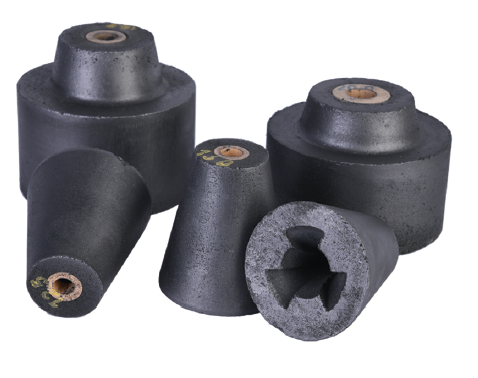
Tundish metering nozzles for controlled steel discharge, including zirconia-insert options described for long service life and stable casting.
Matched nozzle families for nozzle-changing arrangements where bottom-nozzle replacement is required during continuous-casting operations.
Catalogue-listed refractory options associated with three-plate tundish flow-control arrangements; final configurations require approved technical review.
Related tundish lining material: The same company profile also lists tundish cold-setting mass for lining and repair applications. This is a lining material, not a slide-gate component.
Separate application: Slot-type and segment-type gas-purging plugs and housing blocks appear elsewhere on the profile page; they belong to gas-purging systems rather than the tundish nozzle-changing mechanism.
Portfolio source: Saman Tejarat Atousa Company Profile, page 6 (tundish nozzles and gate configurations) and page 9 (cold-setting tundish mass). No dimensions, certified grades or proprietary mechanism models are asserted here.
Tundish Flow-Control Refractory Components
Grouping the components under their corresponding systems makes the diagram easier to interpret and avoids presenting unrelated product cards without context.
Metering-Nozzle Arrangement
Fixed-orifice regulation of the tundish discharge rate.
Exchangeable Nozzle Arrangement
Modular upper and lower outlet components for flexible operation.
Three-Plate Gate Arrangement
Adjustable refractory plate assembly for regulating or stopping flow.
Benefits of an Integrated Tundish Flow-Control System
Typical Continuous-Casting Uses
Information Needed for Technical Selection
Complete operating and dimensional information helps determine the appropriate system, refractory grade and component geometry. Final specifications and suitability should be confirmed with the relevant refractory supplier against equipment drawings and casting requirements.
Related Steel Flow-Control Systems
For upstream ladle flow control and stirring, see our ladle slide gate system and ladle purging plugs and housing blocks.
Typical Tundish Refractory Components
Three catalog visuals show the tundish flow-control components described on this page.
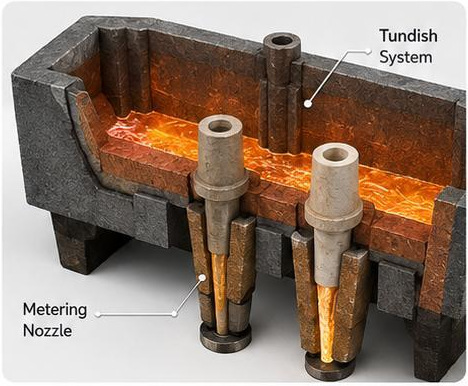
Metering-Nozzle Arrangement
Catalog cutaway showing the tundish and metering-nozzle arrangement.
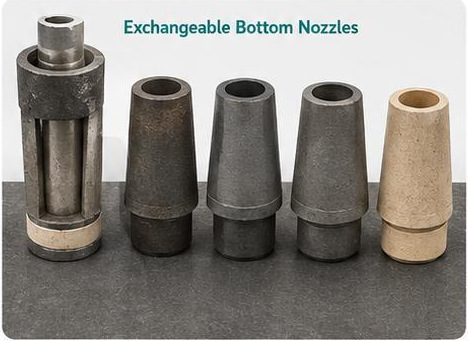
Exchangeable Bottom Nozzles
Exchangeable bottom nozzles shown in the catalog's tundish product range.
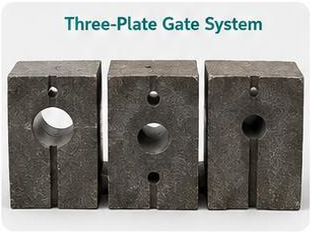
Three-Plate Gate System
Refractory plate set shown in the catalog's tundish flow-control range.
Tundish Nozzle Supply: Three Questions Buyers Ask
Can STA Commerce source tundish nozzles and complete mechanisms?
Yes. Enquiries may cover individual tundish metering nozzles, exchangeable bottom nozzles, nozzle-changer mechanisms, or a complete three-plate gate system. The manufacturer, configuration, availability and delivery terms are confirmed for each request.
Are tundish nozzles the same as tundish lining refractories?
No. Nozzles and gate parts control steel discharge; tundish lining refractories protect and maintain the vessel. See the separately listed tundish cold-setting refractory mass for lining and maintenance enquiries.
What if a tundish nozzle repeatedly clogs?
Nozzle clogging can involve inclusion deposition and operating conditions. Provide the steel grade, deoxidation practice, casting temperature, used-nozzle photos and deposit analysis where available. Material selection alone cannot establish the cause. See published research on nozzle clogging.
Request a Tundish Flow-Control Product Quotation
Send us the required system type, drawings, bore dimensions, casting conditions, quantity and destination country for technical and commercial review.